Queensland Police Fitness Test: Requirements, Pass Standards and Preparation Guide
The Queensland police fitness test requires candidates to pass every set event, so a strong result in one area can't make up for a failed station. The entry test often includes agility, a Push-up test, a 100-metre Swimming test and the Multi-stage fitness test. Check your latest Queensland Police Service invitation and recruiting papers before the test, as the rules and standards can change.
Focused practice works best. Long-distance running alone won't prepare you for quick turns, repeated push-ups or a timed swim. Your plan needs to match the movements, pace and recovery you'll face on assessment day.
What must you complete during the fitness assessment?
The Queensland Police Service uses separate events to test different parts of Physical fitness. Each one has its own pass mark. Testing staff normally guide you through the assessment, explain the course and count valid attempts.
The Queensland Police Service standards are:
- Complete the Illinois agility test in less than 20 seconds.
- Complete 10 correct push-ups.
- Swim 100 metres continuously in four minutes or less.
- Reach at least level 5.5 in the Multi-stage fitness test.
Treat these figures as minimums, not practice goals. If you can only reach level 5.5 on a perfect day, you've got little room for nerves, a slippery turn or poor pacing. Aim to beat each mark in training while using the required technique.
The assessment isn't an Obstacle course. The agility station uses markers and set direction changes, but candidates don't climb walls or carry objects in the usual entry test. Police training may include tougher physical tasks later, so passing the entry assessment should begin your conditioning, not end it.
How does the agility station work?
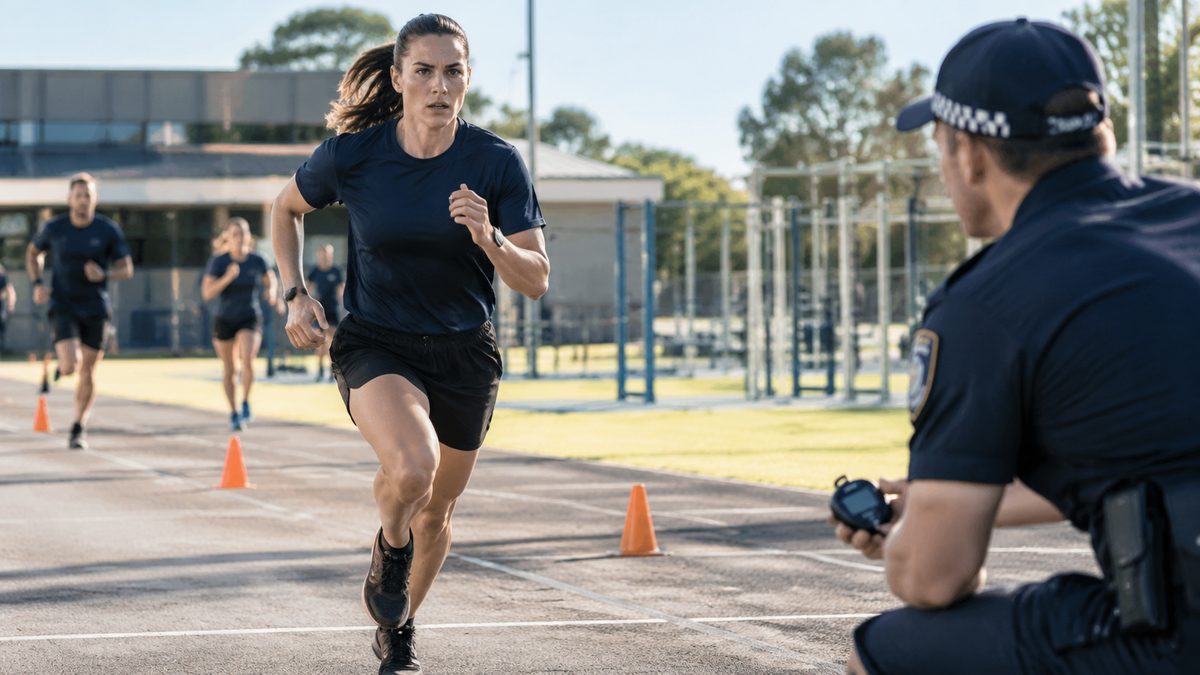
The Illinois agility test how quickly you can speed up, stop and change direction around cones. It includes straight sprints and a weaving section. One missed marker, wrong route or slip can ruin an otherwise quick run.
Learn the route before you chase speed. Walk it until each turn feels automatic, then practise at half pace before trying controlled full-speed runs. Shorten your steps into each turn, lower your hips, plant your outside foot and drive towards the next marker.
Many candidates lose time by standing tall before turning. That pushes force upwards instead of towards the next cone. Others run too wide because they arrive too fast to control their body. Good braking is often faster than wild sprinting.
Practise on a flat, safe surface with correctly spaced cones. Wear the shoes you'll use on test day. Complete four to six timed runs with full recovery instead of doing slow runs while tired. Clean, fast movement is the goal.
What counts as a correct push-up?
The Push-up station checks upper-body strength, trunk control and your ability to repeat a set movement. Only repetitions that meet the assessor's technique rules will count. Poor form can turn 15 attempts into fewer than 10 valid repetitions.
Keep a straight line from your shoulders to your heels. Put your hands in the required position, lower with control and reach the stated depth before pressing to the top. Don't let your hips sag, lift them first or shorten the movement as you tire.
Use strict form from day one. If you can only do a few repetitions, start with your hands on a firm bench and lower the height as you get stronger. Knee push-ups may help a beginner learn control, but they shouldn't replace practice in the tested position.
Strength training should help the tested movement. Rows train the upper back, presses work the chest and triceps, and planks teach your trunk to stay firm. Grip strength helps with later police tasks and general training, but it can't replace valid push-ups. Add carries or hangs after your main work if your hands and forearms tire fast.
A good target is two clean sets of 12 to 15 repetitions without going to complete failure. That gives you some breathing room above the minimum and helps keep your form steady.
How should you prepare for the 100-metre swim?
The Swimming station requires steady forward movement for 100 metres within the set time. Four minutes may feel comfortable for a calm swimmer. But it gets much harder when poor breathing sparks panic in the first lap.
Choose a legal stroke you can maintain. Freestyle is usually quickest, while breaststroke can suit candidates who swim it well. Train in a pool with a known length because four laps of a 25-metre pool feels different from two laps of a 50-metre pool.
Don't start at full speed. Breathe early and exhale into the water rather than holding your breath. A frantic first lap often causes more trouble than the few seconds it saves. Aim for a steady swim, simple turns and no long pause at the wall.
If 100 metres feels tough, begin with short lengths and brief rests. Slowly cut the rest until you can cover the full distance without stopping. Then time yourself once a week. Extra drills should improve your breathing and body position, not leave you wiped out.
Use supervised pool sessions if you're uneasy in the water. Never swim alone or practise breath-holding contests. The entry standard tests safe movement through the water, not risky underwater endurance.
What does level 5.5 on the beep test demand?
The Multi-stage fitness test uses repeated 20-metre shuttle runs paced by audio signals. The speed rises in stages. You must reach the line on time, turn and keep going until you hit the required level or the test ends under its rules.
Level 5.5 doesn't call for elite speed. It takes Aerobic exercise capacity, tidy turns and smart pacing. Candidates often fail because they race ahead of the early beeps, stop at every line or haven't trained with the official audio.
Time your run so your foot reaches the line near the beep. Turn off alternating sides to share the load between your legs. Take a small control step before the line, pivot low and push away without jumping. Save energy during the slow early levels.
One full practice test every one or two weeks is plenty. Too many all-out tests create fatigue without fixing the real problem. Build your engine with easy runs, gain speed through short intervals and work on turns during shuttle sessions.
If you can run steadily for 25 minutes but struggle with the test, your issue may be pacing or turning rather than poor endurance. Film a short practice from the side. You'll soon spot extra steps and wide turns.
How fit should you be before starting a test-specific plan?
You should be able to train several times a week without pain and recover well enough for another quality session. Your starting fitness affects how fast you improve. Still, the assessment rewards useful movement, not looks.
Body composition can affect running economy, heat control and pressure on your joints. It also forms part of wider health and medical checks. Don't chase fast weight loss before the test. Harsh food limits hurt training and can slow recovery. Eat regular meals, choose filling whole foods and let steady training support gradual change.
Your scale weight can't show whether you'll pass. A lighter candidate may lack upper-body strength, while a heavier candidate may still run, turn and swim well. Check your readiness with timed practice under the correct rules.
Deal with any pain that changes your stride or push-up form before hard training. A small niggle can grow when you add shuttles and sharp turns too fast. Raise your weekly workload in small steps and schedule at least one easier day after hard sessions.
What should an eight-week preparation plan include?
An eight-week plan should first build a base, then add test-focused work and cut fatigue before assessment day. Four main sessions a week suit many candidates. Leave enough space between hard running and leg sessions for your knees and calves to recover.
Weeks one and two
Learn the format of every test. Complete one honest baseline attempt without repeating all-out efforts. Do two easy Aerobic exercise sessions of 20 to 30 minutes, one basic Strength training session and one technique session for push-ups, cone movement and relaxed swimming.
Write down valid repetitions and exact times. A note such as “push-ups failed because hips dropped” helps more than “upper body weak.” A clear fault gives you a clear fix.
Weeks three and four
Add one interval workout. Try repeated runs of one to two minutes at a firm pace with easy recovery between them. Keep your other run comfortable. Practise the agility route while fresh, and do short sets of strict push-ups several times through the week.
Swim full lengths at a calm pace. If you can, finish one weekly swim with a timed 100 metres after a full rest. Stop if your form or water safety starts to fail.
Weeks five and six
Make the work more test-specific. Run 20-metre shuttle intervals with clean turns, complete timed agility trials and practise push-ups under the expected counting rules. Do one full Multi-stage fitness test during this phase to measure your progress.
Keep one easy endurance session. Every workout doesn't need to become a test. Your fitness improves after training when sleep, food and gentle movement give your body time to adapt.
Weeks seven and eight
Complete a full rehearsal early in week seven. Follow the expected event order if your candidate material lists it. Use the same shoes, swimwear and warm-up you plan to use on test day.
Cut your total workload in the final week. Keep a few short, quick efforts so you stay sharp, but skip hard sessions during the last two days. You can't build useful fitness that late. You can make yourself sore.
How can you tell whether you are ready?
Complete a controlled mock assessment at least 10 days before the real test. Use measured distances, the official audio and another person to check your repetitions. Counting your own efforts can hide shallow push-ups or late shuttle arrivals.
A solid safety margin means repeatedly finishing the agility run below the limit, doing more than 10 strict push-ups, swimming 100 metres with time left and clearing level 5.5 without a last-second battle. That buffer helps cover a poor turn or normal test-day nerves.
Don't trust one lucky result. Meet the standards again on another day after normal training. Repeatable passes show your plan is working.
If one station is still weak, train the cause of the problem. More running won't fix poor breathing in the pool. More push-ups won't teach you the agility route. Fit the fix to the fault.
What should you do on assessment day?
Follow the arrival time and gear instructions in your official notice. Eat a familiar meal early enough to digest it. Drink as normal instead of forcing down lots of water just before the test.
Warm up in stages. Start with easy movement, take each major joint through a comfortable range, then do a few short efforts that match the next station. Long static stretches right before speed work can make you feel flat.
Listen to every briefing, even when you know the test. Local instructions decide what counts. Ask before you begin if a rule isn't clear. During each station, think about the next marker, repetition or beep, not the final score.
Pack a small kit ahead of time with suitable shoes, swimwear, a towel and any papers listed by recruiting staff. Test day isn't the time to try new shoes, supplements or energy drinks.
Which preparation mistakes cause avoidable failures?
Doing nothing but full practice tests is a common mistake. They measure your result but leave little time for technique work. Train the skills separately in most sessions, then bring them together in planned rehearsals.
Another error is counting bad repetitions. Ten strict push-ups matter more than 20 rushed attempts an assessor may reject. Ask a training partner to watch, or use video to keep your form honest.
Candidates often forget about surfaces and turns. Fitness from straight-road running doesn't fully carry over to repeated 20-metre shuttles. Add turning drills slowly so your ankles, calves and knees have time to adjust.
A last-minute training rush brings sore muscles and a flat performance. Hard work creates fatigue before improvement. Ease back near the assessment and trust the preparation you've already done.
Action takeaway: check the current Queensland Police Service standards, test each event this week, then spend eight weeks improving your weakest result while maintaining the others.