Queensland Police Entry Fitness Test vs Academy Assessments: What Changes?
The entry fitness test checks whether you can meet a set starting standard, while academy assessments test whether you can keep performing as training becomes longer, more complex and more job focused. Passing the entry test proves readiness for one stage. It does not prove that every later physical task will feel easy.
The key change is context. Before entry, you can prepare for known movements under controlled conditions. At the academy, physical work sits beside classes, drills, early starts, practical tasks and recovery demands. Your body must perform while your mind is also working.
This does not mean academy life is a hidden version of an elite sports program. It means the goal shifts. The Queensland Police Service needs recruits who can learn, recover and perform safely across repeated demands. A narrow plan aimed at scraping through one test leaves little room for that shift.
Why does the purpose of assessment change after entry?
The entry process needs a clear gate. Candidates come from different work, sport and exercise backgrounds, so a standard assessment gives the Queensland Police Service a common way to check minimum readiness. entry test
Academy staff have a different task. They must develop recruits for operational work. That work can involve short bursts of effort, controlled movement, lifting, carrying, changing direction and making sound choices while breathing hard. Academy assessment therefore sits inside a wider learning program rather than acting as one isolated hurdle.
Think of entry as proof that you have built the base. Academy work asks whether you can use that base. A candidate may produce a good result when fresh yet lose movement quality after several busy days. Another may enter with solid general fitness and adapt well because they recover, listen to coaching and keep their effort steady.
This difference changes how you should view a pass. It is permission to start the next phase, not a reason to stop preparing.
What changes when fitness becomes part of a full training week?
Before entry, you control much of your Training. You choose the session time, adjust the load and often arrive fresh. At the academy, physical work must fit around the course timetable. You may need to learn practical skills after exercise or complete exercise after hours of concentration. entry test
The single session may not be the hardest part. The build-up across the week often causes more trouble. Legs that felt strong on Monday may feel heavy later in the week. Poor sleep can slow reactions. A rushed meal can leave a recruit flat during Aerobic exercise. Small weaknesses become easier to spot when recovery time is limited.
A useful comparison comes from physical jobs. Someone doing Environmental remediation may be able to lift one heavy object with ease. The true work demand appears when that person must wear equipment, move across uneven ground and repeat the task safely throughout a shift. Academy fitness follows the same basic rule: repeatable capacity matters more than one impressive effort.
This is why training volume should rise in small steps before entry. Sudden increases in running, circuits or loaded work can cause pain at the exact time consistency matters most.
How do movement demands become more applied?
The entry test separates qualities so they can be measured. One part may test running capacity. Another may test Agility, swimming ability or upper-body control. That structure makes scoring clear.
Academy activities can combine those qualities. You may need to accelerate, stop under control, change direction and then complete a skill while tired. The body does not treat these as separate boxes. Foot position affects balance. Trunk control affects how force moves through the arms. Poor braking can turn speed into a risk.
Agility also becomes more than moving quickly around markers. Good applied movement includes seeing where you need to go, choosing a safe path and controlling your speed. A fast turn that leaves you off balance has little value.
This catches out candidates who train only by repeating a test course. They learn one path but do not build broad movement skill. A better base includes short accelerations, planned direction changes, safe stopping and simple reaction drills. Each drill should stay clean before speed rises.
Does strength matter differently at the academy?
Entry standards use movements that are easy to judge in a fair way. Academy demands can expose strength through practical positions and repeated work. Physical strength matters, but useful strength is force you can control.
A recruit may have a strong bench press yet struggle to hold posture during repeated ground-based work. Another may run well but tire quickly when carrying an awkward load. These gaps do not mean the person is unfit. They show that fitness is specific to the task.
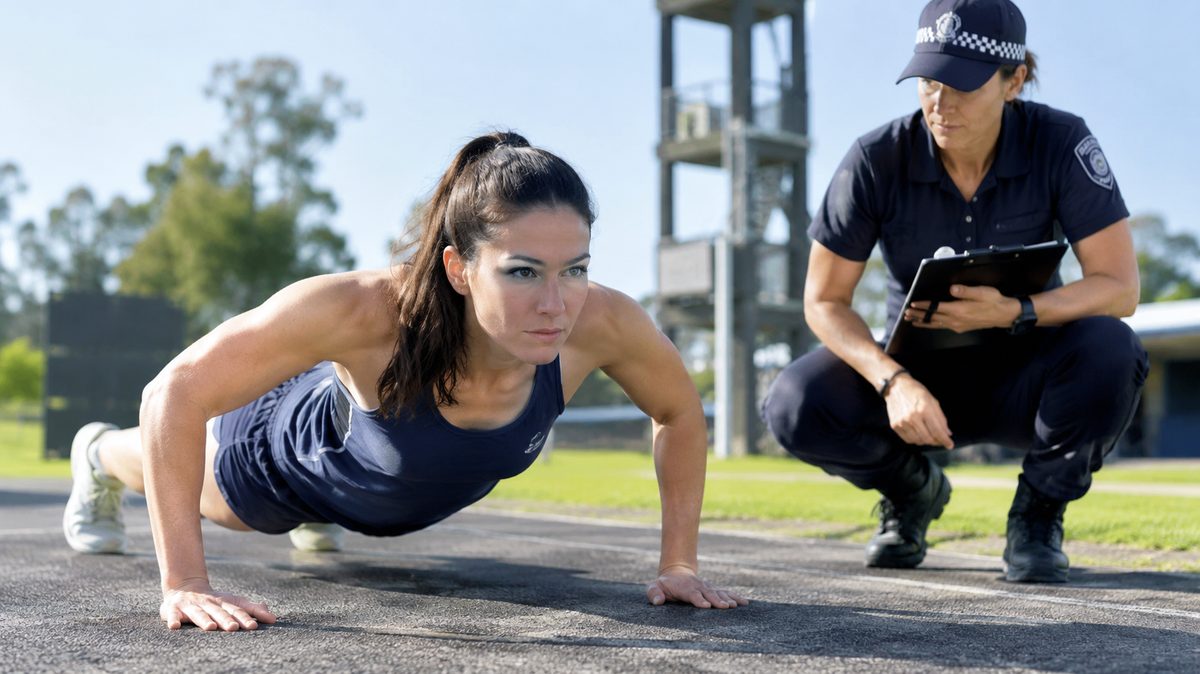
Upper-body preparation should extend beyond one Push-up score. The Push-up remains useful because it develops pressing strength, trunk stiffness and control without complex equipment. Yet pulling work, loaded carries and steady holds help build a more complete base.
Grip strength deserves direct attention. Hands and forearms can tire during carrying, holding or repeated practical tasks. Weak grip can also make the shoulders and back work harder as the body tries to compensate. Farmers carries, towel holds and controlled hanging can build grip strength with simple equipment. The load must allow good posture and pain-free control.
Strength work does not need to copy police duties. In fact, trying to imitate unknown drills can create poor habits. Build basic patterns well: squat, hinge, push, pull, carry and brace. Qualified academy staff can then teach the required applications.
Why does endurance become more than a run score?
Entry running assesses a defined part of Physical fitness. Academy Endurance includes the ability to repeat useful effort, settle your breathing and return to work without a long drop in quality.
A candidate who trains only at maximum speed may improve one score while remaining poor at recovery. Every session feels like a test. Legs stay sore, easy runs become races and progress stalls.
A stronger approach uses easy aerobic work as the base. It should feel controlled enough to speak in short sentences. Add one harder running session and one session with brief changes of pace. This builds speed while preserving the recovery needed for strength and movement training.
The missed skill is often downshifting. After a hard effort, relax the shoulders, regain a steady rhythm and control the next action. In practical settings, the task may continue after the first burst. Fast recovery protects decision quality and movement control.
Swimming, cycling or rowing may support aerobic capacity with less impact, but candidates should still run if running forms part of their assessed preparation. Fitness transfers between activities only in part.
What happens to technique when you are tired?
Fatigue makes small faults larger. Knees may fall inward during a landing. The lower back may sag during a Push-up. A recruit may rush a turn and lose balance. The result is wasted energy and a higher chance of pain.
Entry practice often happens while fresh because candidates want their best score. Academy preparation also needs some safe work under mild fatigue. This does not mean using poor form until failure. It means checking whether sound movement lasts beyond the first easy set.
For example, complete a controlled run interval, recover briefly and then perform a small set of clean bodyweight movements. Stop when technique changes. The aim is to keep quality, not prove toughness.
Video can help. A side view of a set may reveal a shortening range or shifting trunk that you cannot feel in the moment. Fix one fault at a time. More repetitions of a poor pattern only make that pattern familiar.
How much does mental load affect physical performance?
Physical tasks feel different when you must listen, remember instructions and respond at the same time. Mental load can make people rush. It can also make them hold their breath or miss a simple direction.
Academy learning adds this layer because fitness is no longer the only focus of the day. A recruit may be physically able to finish a drill yet make errors because attention drops under stress.
You can prepare without inventing police scenarios. Ask a coach to give a simple direction before a movement drill. Use changing colour or number cues during low-risk footwork. Count breathing cycles during recovery. These methods train attention while keeping the exercise safe and general.
The goal is calm action. Trying to create extreme stress in ordinary gym sessions adds injury risk and teaches little. Build confidence through clear tasks, gradual pressure and accurate movement.
Should your target stay at the minimum after you pass?
No. A minimum result gives you no spare capacity for a poor night of sleep, hot weather, nerves or accumulated fatigue. You need a buffer, but chasing extreme scores can also harm preparation if it causes injury or drains recovery.
A useful buffer means you can meet the known entry requirement with clean form on an ordinary day, not only during a perfect practice attempt. You should also finish routine training without needing several days to feel normal.
Measure more than best results. Track how often you complete planned sessions, whether pain is rising, how quickly breathing settles and whether movement stays clean late in a workout. These signs say more about academy readiness than one personal record.
Physical fitness can also fall during the gap between assessment and intake if training stops. Keep a steady maintenance plan after passing. Reduce risky testing, retain aerobic work and continue basic strength sessions. Use a structured Queensland Police fitness preparation resource to track your progress through the gap.
What should change in your preparation plan?
Move from narrow test practice toward a broad base while keeping enough test-specific work to remain familiar. The exact balance will change with your current weak points and the official requirements that apply to your intake.
A practical week can include:
- Two aerobic sessions: one easy session and one controlled harder session.
- Two strength sessions: use basic lower-body, pushing, pulling, carrying and grip work.
- One movement session: practise acceleration, braking and direction changes with full control.
- Short mobility and recovery work: address stiff areas and protect sleep rather than adding another hard workout.
Some sessions can share a day if total load stays sensible. Keep at least one low-load day each week. Increase only one main factor at a time, such as distance, speed, weight or number of sets.
Use official Queensland Police Service material as the source for current entry standards, academy directions and test rules. Intake instructions can change, and advice from past candidates may describe a different course period. If your documents name an assessment or standard, train for that exact requirement while keeping the wider base described here.
Which preparation mistake creates the biggest gap?
The biggest mistake is treating the entry assessment as the finish line. Candidates who stop training after a pass can lose running rhythm, strength and tissue tolerance before academy work begins. Candidates who train only the tested events may arrive with gaps in carrying capacity, recovery or movement control.
The answer is steady preparation rather than constant testing. Test sessions show where you stand, but training sessions create change. Most weeks should build capacity through repeatable work that leaves you able to train again.
Watch for pain that changes how you move, lasts after normal recovery or grows each week. Seek advice from a suitable health professional instead of masking it and adding more load. A short change to training is easier to manage than an injury close to intake.
Your next step is to compare your current week with academy-style needs today, then add one missing element, aerobic recovery, full-body strength, controlled agility or grip work, while keeping the official entry tasks in your plan.